Water softener and filtration service in Saratoga Springs, UT means testing your water, picking the right treatment and installing or repairing it on the cold water line that feeds your home. A softener removes hardness minerals, a carbon filter tackles taste and odor, and reverse osmosis treats one tap. The wrong choice wastes money, so we start with a test of your tap. We dispatch 24/7 for plumbing emergencies, but this page is about planning.
Test your tap before you buy anything
Every treatment decision starts with a number. Hardness is measured in mg/L as calcium carbonate, and USGS classes run from soft at 0 to 60, moderately hard at 61 to 120, hard at 121 to 180 and very hard above 180. A low-cost test kit or a lab test gives you a reading.
The City of Saratoga Springs 2024 drinking water report lists total dissolved solids from 144 to 672 ppm, and it lists no hardness value. Those totals do not tell you how hard the water is. Ask your water utility for its annual water quality report and test your tap, so the decision rests on your own reading.
Do not skip the test
A softener on water that is already moderate wastes salt. A filter chosen for the wrong contaminant does nothing. A twenty dollar kit is cheaper than a mistake.
Signs your water may need treatment
Symptoms to match to a test result
- White crust on faucets, shower heads and kettles
- Soap that will not lather and dry, tight skin after a shower
- Spots on glasses and dishes
- A chlorine taste or smell at the tap
- Short lifespan for water heaters and tankless heat exchangers
Scale and spots point to hardness. Taste and smell point to chlorine or other dissolved compounds. The City chlorinates its water, so a carbon filter often fixes a chlorine taste without touching hardness.
Softener, conditioner, carbon and reverse osmosis compared
| Treatment | What it does | What it does not do |
|---|---|---|
| Salt-based softener | Swaps calcium and magnesium for sodium or potassium so scale does not form | Does not remove chlorine, taste or most other contaminants. Needs salt and a drain. |
| Salt-free conditioner | Changes how scale forms so it clings less | Does not lower hardness readings. Results vary by water and product. |
| Whole-home carbon filter | Reduces chlorine, taste and odor for the whole house | Does not soften. Cartridges or media must be replaced. |
| Reverse osmosis (under sink) | Treats drinking and cooking water at one tap and reduces dissolved solids | Does not treat the whole house. Wastes some water and needs a tank and a drain. |
Choose by test result and by what you want fixed. Look for third-party certification for any contaminant claim.
Water softener installation and repair
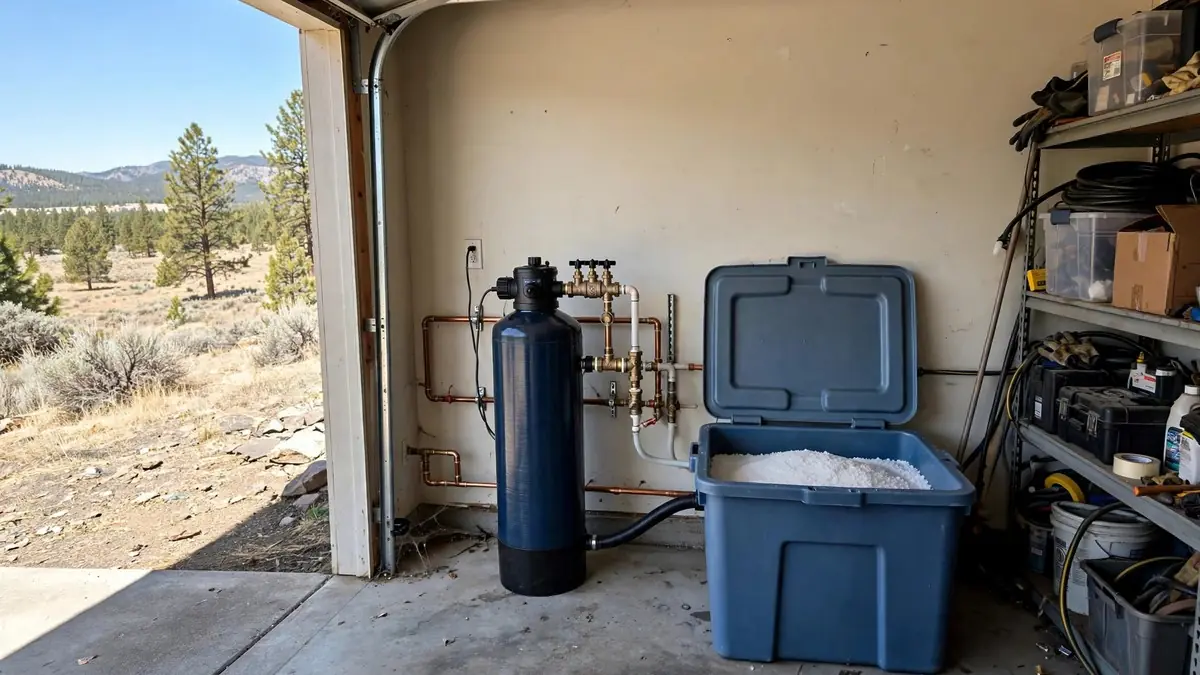
A softener installs on the cold water line after the main shutoff and before the water heater. It needs a drain for regeneration, power for the control head and space for a salt tank. Bypass valves let you isolate it for service.
Common repairs include a stuck valve, a salt bridge in the brine tank, a clogged injector, a failed control board and resin that has worn out. We diagnose first. If the resin is spent, a new unit may make more sense than a new control head. Softened water also affects hot water equipment, which is covered on tankless water heater service.
Need a plumber right now?
The 24/7 line is open. A dispatcher will book a licensed plumber.
Water conditioner repair
A conditioner has fewer moving parts than a softener, so repair is often about the cartridge, a sensor or the power supply. If your results have changed, test the water again before replacing anything. Ask the maker how often to replace the media.
Whole-home filtration and drinking water filters
A whole-home filter treats every tap and works best on one specific complaint, such as chlorine. A point-of-use filter or reverse osmosis system handles drinking water only. Match the filter to the contaminant on your test.
The City 2024 report lists lead at 1.7 ppb and copper at 0.076 ppm, both below action levels. If you want an extra layer, a certified filter at the kitchen tap can help, and a lab test confirms what your own pipes add.
Pressurized irrigation water is not for the drinking filter plan
The City runs a separate pressurized irrigation system that is non-potable and is never for drinking, cooking or play. It must not connect to your drinking water or any filter on it. Cross-connections between culinary and irrigation lines are illegal. The softener and filters on this page belong on culinary water only, and we can point out which line is which.
What affects the price of softener and filtration work
Treatment type
A carbon filter, a softener and a reverse osmosis unit are different price levels.
Water test results
Hardness and flow rate set the size of the unit.
Plumbing and drain access
A drain and an outlet near the main line make installs simpler.
Bypass and shutoff valves
New valves are often part of the job.
Ongoing costs
Salt, cartridges and media replacement are part of owning the system.
A note on insurance
Homeowners insurance does not cover water treatment equipment or its upkeep. If a leak from the equipment damages the home, check your policy.
Want your real number? Call (385) 488-1892 with your test result or a photo of the main line.
Water treatment across Saratoga Springs and nearby towns
We cover Saratoga Springs and nearby Lehi and Eagle Mountain. If you want to know which of your pipes run to the water heater first, see water heater installation.
Frequently asked questions
The City 2024 report lists no hardness value, so we will not state one. Ask your water utility and test your tap. USGS classes help you read the result.
Test first. If your reading is hard or very hard and you see scale, a softener may help. If it is soft or moderate, you may not need one.
A softener removes hardness minerals. A conditioner changes how scale forms and does not lower the hardness reading.
No. Pressurized irrigation water is non-potable and is never part of the drinking-water plan.
No. A carbon filter is the usual fix for chlorine taste and odor.
Yes. We diagnose valves, control heads, brine tanks and cartridges.
Still unsure? Call (385) 488-1892
Sources and references
Local facts on this page come from public pages like these. The city lists the 2021 International Plumbing Code (IPC) as adopted, and permit rules vary by job, so ask the Saratoga Springs building department before work starts. Page last reviewed 2026-10-15.