
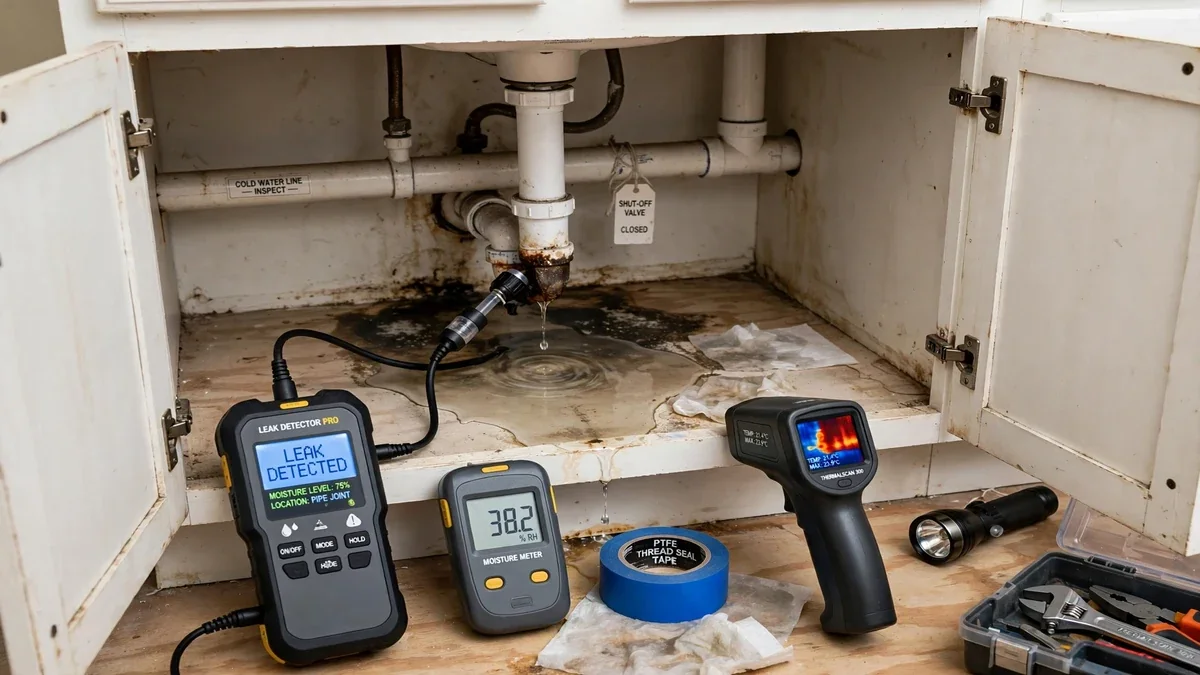
A water meter that moves when nothing in the house is on means water is leaking somewhere after the meter, and a high water bill in Saratoga Springs, UT is often the first sign. Turn off everything that uses water, read the meter, wait and read it again. Then close the main shutoff valve and watch whether the meter stops. That tells you if the leak is inside the house or in the buried pipe.
The steps are below, followed by a table of what each result means. If the test points to the pipe in your yard, a plumber has tools that find the break without digging up the lawn.
The meter test, in order
- Stop all water useTurn off taps, the dishwasher, the washer and the ice maker, and check that no one is showering. Pause any softener regeneration.
- Find the meter and read itLift the meter lid and note the numbers or the small dial. Many meters have a low-flow indicator that turns even with a tiny flow.
- Wait 15 to 30 minutesDo not use any water. Read the meter again. Any change or a turning low-flow dial means water is escaping.
- Close the main shutoffShut the main valve where the line enters the house, then watch the meter for a few minutes.
- CompareIf the meter stops, the leak is inside the house. If it keeps moving, the leak is between the meter and the main valve, or the meter itself needs checking.
What each result usually means
| What you see | Likely location | Next step |
|---|---|---|
| Meter moves, stops when the main valve is closed | Inside the house: a toilet, a faucet, a supply line, or a pipe in a wall or slab | Toilet dye test, then a leak locate if the toilets are clean |
| Meter keeps moving with the main valve closed | The buried line between the meter and the house, or the valve itself | Call a plumber for a locate and a water line repair |
| Meter moves slowly, bill up slightly | A toilet flapper, a dripping faucet or a leaking irrigation valve | Check toilets and outdoor valves |
| Meter spins fast, wet ground or sound of running water | A broken line or an open pipe | Shut the main valve and call now |
| Meter is still, bill is high | Past use, a meter read problem or irrigation use | Check the usage portal for the time of the spike |
A plumber confirms the source with listening gear, pressure testing or a thermal camera.
The toilet dye test, because toilets are the usual suspect
A flapper that does not seal lets water trickle into the bowl without a flush, and it is the most common hidden leak in a home. Put a few drops of food coloring in the tank and wait 15 minutes without flushing. If color shows up in the bowl, the flapper or fill valve is leaking.
A new flapper is a small part. If the toilet is old, cracked or running often, our toilet repair page covers repairs and replacements.
Do not assume it is irrigation, or that it is not
In summer, sprinklers are a major source of water use. Pressurized irrigation is a separate non-potable system that the city charges starting the week of April 15 and drains the week of October 15, so a spike in winter is not coming from the sprinkler system running.
In the spring, give the system two weeks after charging before you judge your pressure. A valve that sticks open or a broken sprinkler head can run unnoticed for days, so look at the yard as well as the house.
Need a plumber right now?
The 24/7 line is open. A dispatcher will book a licensed plumber.
A leak you can hear versus one you cannot
Water running behind a wall, a hot spot on a slab floor, a musty smell or a section of lawn that is wetter than the rest all point to a leak you cannot see. These are the cases where leak detection uses acoustic listening, thermal imaging and pressure tests to find the spot before anything is opened.
Our leak detection team uses those tools, and when the line is the culprit, water line repair replaces the damaged section. The sooner it is found, the smaller the repair and the lower the water loss.
Reading the portal alongside the meter
The meter shows what is happening now, and the portal shows what happened while you were at work or asleep. If the hourly line never drops to zero overnight, water is moving through the pipes when no one is using it.
Take a screenshot of the hourly graph and share it with the plumber. A leak that began on a certain day narrows the list of causes, such as a repair, a new appliance or a change in the sprinkler schedule.
A leak that stops on its own
A leak can hide when a fixture seals itself or when a valve is closed. If the portal shows a spike that ended, the cause may still be there, such as a toilet that sticks only some days. Run the dye test anyway.
What to do while you wait for help
If the meter keeps moving
- Close the main valve if water is pooling or the meter is racing
- Open one low faucet to relieve pressure if you have to leave the valve closed for hours
- Photograph the meter reading and the time, so the leak can be timed later
- Move belongings off wet floors and keep electrical items away from standing water
- Note the date and size of the last bill spike
Calling us from nearby towns
We dispatch from Saratoga Springs and also take leak calls in Lehi and American Fork. The meter test is identical anywhere, so you can run it before you call and give the dispatcher your result.
Saratoga Springs: the My Water Use portal and irrigation season
The City of Saratoga Springs My Water Use portal lets residents see hourly water use and make monthly and yearly comparisons for both the culinary and the irrigation systems. Residents can also set alerts for a sudden increase in either system, and the city says this helps identify potential leaks. Open it during your meter test: a steady overnight flow on the hourly graph confirms a leak and tells you roughly when it began.
Pressurized irrigation is a separate non-potable system. Charging begins the week of April 15 and the system is drained the week of October 15, then stays inactive until spring. If the portal shows irrigation use outside those dates, or culinary use that never drops overnight, you have a clue about which side to check first.
Source: city utility page
Frequently asked questions
Fifteen to 30 minutes with no water use is enough to see a slow leak on most meters. If the low-flow indicator moves right away, you already have your answer. A very slow leak may take longer to show on the numbers.
The spike may come from a past leak that stopped, a long irrigation run, or a billing cycle that covered more days. Check the usage portal for the hours when the water ran, then compare it against what you remember.
Yes. A flapper that does not seal can run all day and night, and the water adds up quickly. The dye test takes 15 minutes and costs a few drops of food coloring.
Utilities generally do not own the pipe past the meter, and the line between meter and house may belong to the homeowner. Ask the City of Saratoga Springs utility billing office about its rules for your account.
Yes. The city's My Water Use portal shows hourly water use and monthly and yearly comparisons for both culinary and irrigation water, and you can set alerts for a sudden increase. Property owners must receive a utility bill to register.
Still unsure? Call (385) 488-1892
Sources and references
Local facts on this page come from public pages like these. The city lists the 2021 International Plumbing Code (IPC) as adopted, and permit rules vary by job, so ask the Saratoga Springs building department before work starts. Page last reviewed 2026-10-15.