
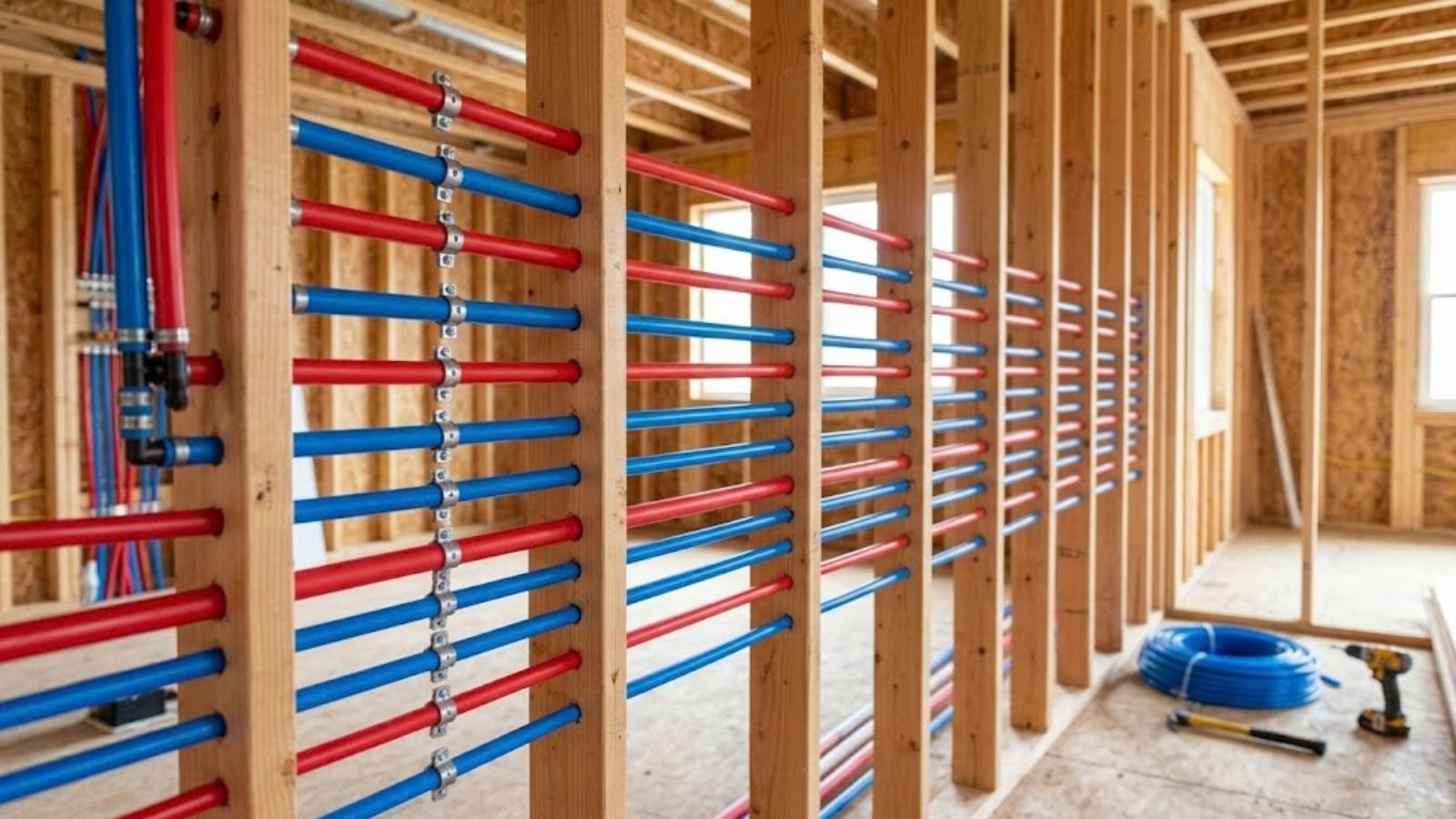
You should repipe when your supply lines are failing in more than one place, when the pipe material itself is known to fail, or when corrosion has cut your water flow. One pinhole leak does not call for new pipes. Three leaks in a year, brown water that starts at the pipe, or galvanized steel throughout usually does. The decision rests on the pattern and the material, not on age alone. We explain how below.
Most homes in Saratoga Springs were built after 2001, so a whole-house repipe is less common here than in older towns. That is good news for many owners, and it also means you should rule out simpler causes first. Our decision table below shows how to read the signs.
A decision table: repair, partial repipe or full repipe
| What you see | Likely a repair | Points toward repiping | First step |
|---|---|---|---|
| Pinhole leak | One leak, pipe otherwise sound, clear cause such as a bad fitting | Several leaks in different spots within a year or two | Locate and document each leak |
| Brown or rusty water | Only at one tap, or after water heater work, flush clears it | Rust at every tap, especially hot and cold, returns after flushing | Test at the meter side and inside |
| Low pressure | One fixture, usually a clogged aerator or cartridge | Every fixture weak, meter side pressure is fine | Check the pressure at an outdoor spigot |
| Pipe material | Copper or PEX in good condition | Galvanized steel, or a material with a known failure record | Identify the pipe and where it was made |
| Water stains or damp walls | A single drain or fixture leak | Supply leaks that keep reappearing in new places | Pressure test the lines |
A table cannot replace a camera and a pressure test. Treat it as a way to ask better questions.
Pinhole leaks: one is a repair, a pattern is a decision
A pinhole is a tiny hole worn through the wall of a pipe, often from the inside. One can come from a manufacturing flaw or a poor fitting, and a clean repair ends it. Several in a short span suggest the whole run is thinning.
Before you choose, find every leak. Leak detection with acoustic listening, a pressure test or a thermal camera shows where water is escaping and how many separate spots you have. That count is what makes the decision, not a guess.
Discolored water: pipe, water heater or the street?
Rust-colored water is a symptom, not a diagnosis. If it appears only on the hot side, the water heater tank may be shedding sediment or corrosion. If it appears on the cold side at every tap, the supply pipes are suspect.
A quick check helps: run the cold tap nearest the main for a few minutes. If it clears, the sediment is local to one branch. If it stays discolored, test the water at the meter side or ask your utility whether it is flushing mains in your area.
Low pressure that only some fixtures have
Pressure that is weak at every fixture while an outdoor hose bib is strong suggests a restriction inside the house. Galvanized steel is the classic cause because mineral buildup and rust narrow the inside of the pipe. Pressure that is weak at one fixture is usually a clogged aerator or worn cartridge, which a simple repair fixes.
PEX or copper: how the two compare
| Feature | PEX | Copper |
|---|---|---|
| Flexibility | Bends around corners, fewer fittings | Rigid, needs elbows and joints |
| Joints | Crimp, clamp or expansion fittings | Soldered or press fittings |
| Install effort | Usually quicker to run through walls | More labor in tight framing |
| Corrosion | Does not corrode like metal | Can pit or develop pinholes in some water |
| Heat and sunlight | Needs protection from UV light and some heat sources | Handles heat well, no UV concern |
| Cost | Material is often cheaper | Material usually costs more |
Both are widely used. The right choice depends on your framing, your budget and what your plumber is licensed and experienced to install.
Need a plumber right now?
The 24/7 line is open. A dispatcher will book a licensed plumber.
What a plumber checks before recommending a repipe
The inspection that should come first
- Pipe material at the main shut-off, water heater and under sinks, since the visible pipe usually matches the hidden run
- Static water pressure at an outdoor spigot, compared with pressure at fixtures inside
- A pressure test of the supply lines with all fixtures off, to count leaks that are not visible
- The interior of an old pipe, where a section can be cut out and examined for scale or pitting
- Whether leaks cluster on one run, which supports a partial repipe
Galvanized steel and other older pipe
Galvanized steel was common in older houses. It rusts from the inside, so the opening narrows and flow drops long before the pipe leaks. If your house is plumbed in it, low pressure and brown water at every tap are expected, and repair usually only delays the repipe.
Homes in this city were mostly built after 2001, so galvanized supply pipe is unlikely here. It is far more likely in older housing in other towns, which is why a repipe is a common question there and a rare one in newer neighborhoods.
What a repipe looks like and what to expect
A repipe replaces the supply lines from the main shut-off to each fixture. Plumbers usually open small access holes in the drywall, run new lines and patch the wall. The water is off for most of a work day or more, depending on the house.
A partial repipe, such as one bathroom or one leaking run, costs less and may be all you need. Our repiping page explains scope, and we can tell you honestly whether a partial job covers the problem.
What changes the cost of a repipe
Size of the house
More fixtures and longer runs mean more pipe and more labor.
Access to the framing
Open ceilings in a basement make the work simpler. Finished walls need more patching.
Material choice
PEX and copper differ in material cost and in install time.
Whole house or partial
One bathroom or a single leaking run costs far less than every fixture.
Drywall repair
Access holes must be patched and painted, and that can be handled separately.
Nearby towns with older housing stock
Older homes are more likely to have old supply piping. Lehi has a historic core settled in 1850 alongside very recent growth, so house age there varies a lot. We serve Lehi and American Fork and see different pipe materials depending on when a house was built.
Saratoga Springs: what the city water report says and does not say
The city's 2024 Annual Drinking Water Quality Report lists total dissolved solids of 144 to 672 ppm against a limit of 2000 ppm. It lists lead at 1.7 ppb and copper at 0.076 ppm at the 90th percentile, both below action levels. The city and Central Utah Water Conservancy District chlorinate the water.
The report lists no hardness value. If you see scale or pinholes, ask your utility for the annual report and test your tap before blaming the pipes. Those results are for sampled homes, not for yours.
Source: city water quality report (2024)
Frequently asked questions
It varies with the size of the house and the number of fixtures. Many repipes take a few days, with water off for part of each day. Ask your plumber for a schedule before work starts.
Rarely. Most newer homes use copper or PEX, which usually has long service left, though leaks can still happen. If you have a leak, find the cause first. A single repair is often all that is needed.
Yes, when the problem is confined. One bathroom, one wall or a single leaking run can be replaced without touching the rest. A full repipe makes sense when leaks keep appearing in new places.
Only if the pipes are the restriction. Check pressure at an outdoor spigot first. If pressure is fine there but weak inside, a restriction in the house plumbing is likely.
No. The city reports 90th percentile results from sampled homes, and they were below action levels. They do not test your house. To learn about your own plumbing, test your tap and ask your utility.
Still unsure? Call (385) 488-1892
Sources and references
Local facts on this page come from public pages like these. The city lists the 2021 International Plumbing Code (IPC) as adopted, and permit rules vary by job, so ask the Saratoga Springs building department before work starts. Page last reviewed 2026-10-15.